ChatGPT's Web Searches Are 56% Longer Than Gemini's
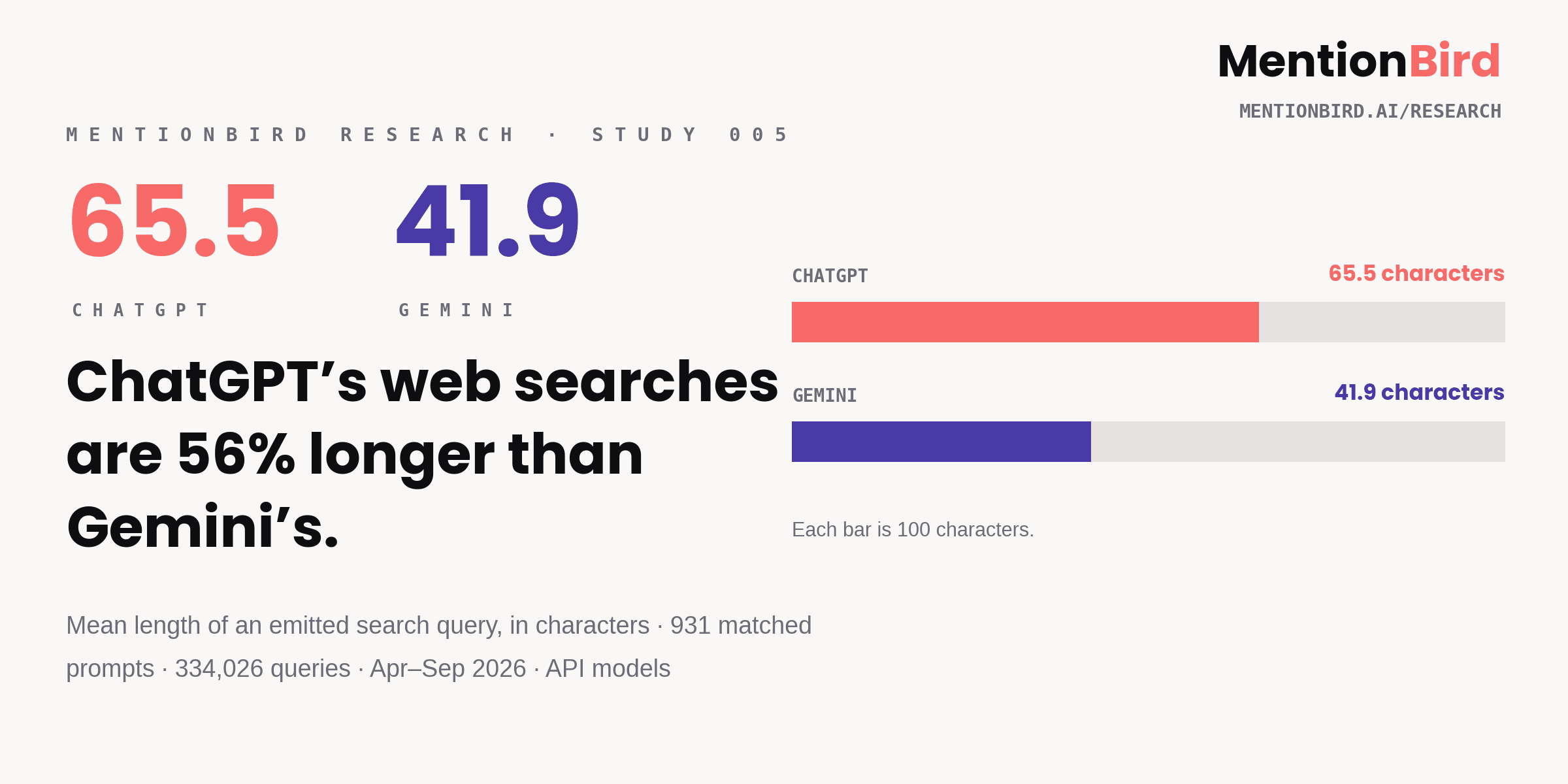
- Across 334,026 search queries emitted on 41,547 matched prompt-days between April 27 and September 15, 2026, ChatGPT’s queries averaged 65.5 characters and Gemini’s averaged 41.9. ChatGPT’s are 56% longer.
- In words, ChatGPT averaged 8.83 and Gemini 6.02 (n=179,389 and 154,637 queries). The medians are closer: 8 words against 6.
- 35.6% of ChatGPT’s searches ran to ten words or more. For Gemini the figure is 2.4% (n=179,389 and 154,637 queries).
- Gemini never emitted a query longer than 17 words in 154,637 attempts. ChatGPT’s longest was 48 words.
- 98.7% of Gemini’s queries fit inside 70 characters. For ChatGPT, 63.5% do. ChatGPT sent 17,123 queries over 100 characters. Gemini sent eight.
- ChatGPT starts broad and narrows. Its second search averages 9.46 words and its seventh averages 7.12 (n=41,862 and 5,791 queries). Gemini moves 0.6 words across the same range.
- The gap held through a change of ChatGPT model inside the window. Before the change ChatGPT’s queries were 54.8% longer in characters. After, they were 60.8% longer (n=134,214 and 45,175 ChatGPT queries).
An AI answer engine is a tool that answers a question in prose instead of handing back a list of links. ChatGPT is one. Gemini is another.
Before it answers, an engine often goes and looks something up. To do that it has to write a search query of its own. It takes your question, decides what to look for, and types a string into a search index. That string is what we call an emitted search query. It is written by the model, not by you, and it never appears on screen.
This study is about those strings. Not about what the engine cited. Not about which brand won. Only about what the engine typed.
Two terms we use throughout. A head term is a short, broad search of a word or two, like the ones people type into Google. A long-tail search is a longer, more specific one. Search marketers have spent two decades splitting content strategy along that line, which is why the length of these machine-written queries matters.
We count length two ways: in characters, and in words separated by spaces. Both are reported for every finding.
What we set out to answer
Almost every discussion of AI visibility is about what an engine cites. Very little of it is about what the engine asks.
That order is backwards. The query comes first. It decides which pages are even in the running before ranking becomes a question. If the engine types something narrow, a broad page never enters the set.
So we asked one thing. When these engines search, how long is the string they type?
How we measured it
The unit of analysis is one emitted search query, from one engine, inside one answer.
The design is matched. A prompt-day counts only when both engines ran the same prompt on the same day, and both actually searched. That removes the usual objection to engine comparisons, which is that one engine was handed easier or more topical questions. Both engines saw the same 931 commercial-intent prompts on the same days.
That gives 41,547 matched prompt-days between April 27 and September 15, 2026. Inside them sit 334,026 queries: 179,389 from ChatGPT across 42,024 answers, and 154,637 from Gemini across 42,083 answers. ChatGPT averaged 4.27 searches per answer and Gemini 3.67.
We measured API models, not the consumer apps. The models were gpt-5.6-luna from OpenAI and gemini-2.5-flash from Google, both called through their APIs with web search enabled. ChatGPT.com and gemini.google.com are different products with their own retrieval behavior. Numbers from the apps would differ.
Word count is whitespace-delimited. A hyphenated phrase counts as one word. So does a search operator. That rule is crude, and it is the reason we lead on characters rather than words.
Exclusions, and their size. Matching dropped 59,585 Gemini queries and 13,060 ChatGPT queries. Most of the dropped Gemini queries come from days when ChatGPT answered from memory and ran no search at all, so Gemini had no partner. That asymmetry is itself a finding from how often ChatGPT searches the web before it answers, which found ChatGPT returns no web citations on 29.7% of answers. Two other engines were captured and dropped: Perplexity’s API exposes no emitted queries at all, and Claude produced 31 queries, below our floor of 100.
We do not publish prompt text, prompt-level rows or brand names. We do not report a percentage for any group smaller than 100. Every percentage here carries its base n.
This is a large but imperfect sample. Our prompt mix leans toward ecommerce, SaaS and agency services. Query length in other categories may differ, and we have not tested them.
ChatGPT’s search query is 56% longer than Gemini’s
Across the matched set, ChatGPT’s average query ran to 65.5 characters. Gemini’s ran to 41.9. That is a gap of 56%, and it is the single number this study exists to report. In words the gap is 47%: 8.83 against 6.02.
The medians are much closer than the means. ChatGPT’s median query is 8 words. Gemini’s is 6. A two-word difference sounds small, and on its own it would be. The means pull apart because one engine has a long tail of very long queries and the other does not.
ChatGPT also searches slightly more often, at 4.27 searches per answer against 3.67. So the difference in total text is larger than the per-query gap alone suggests.
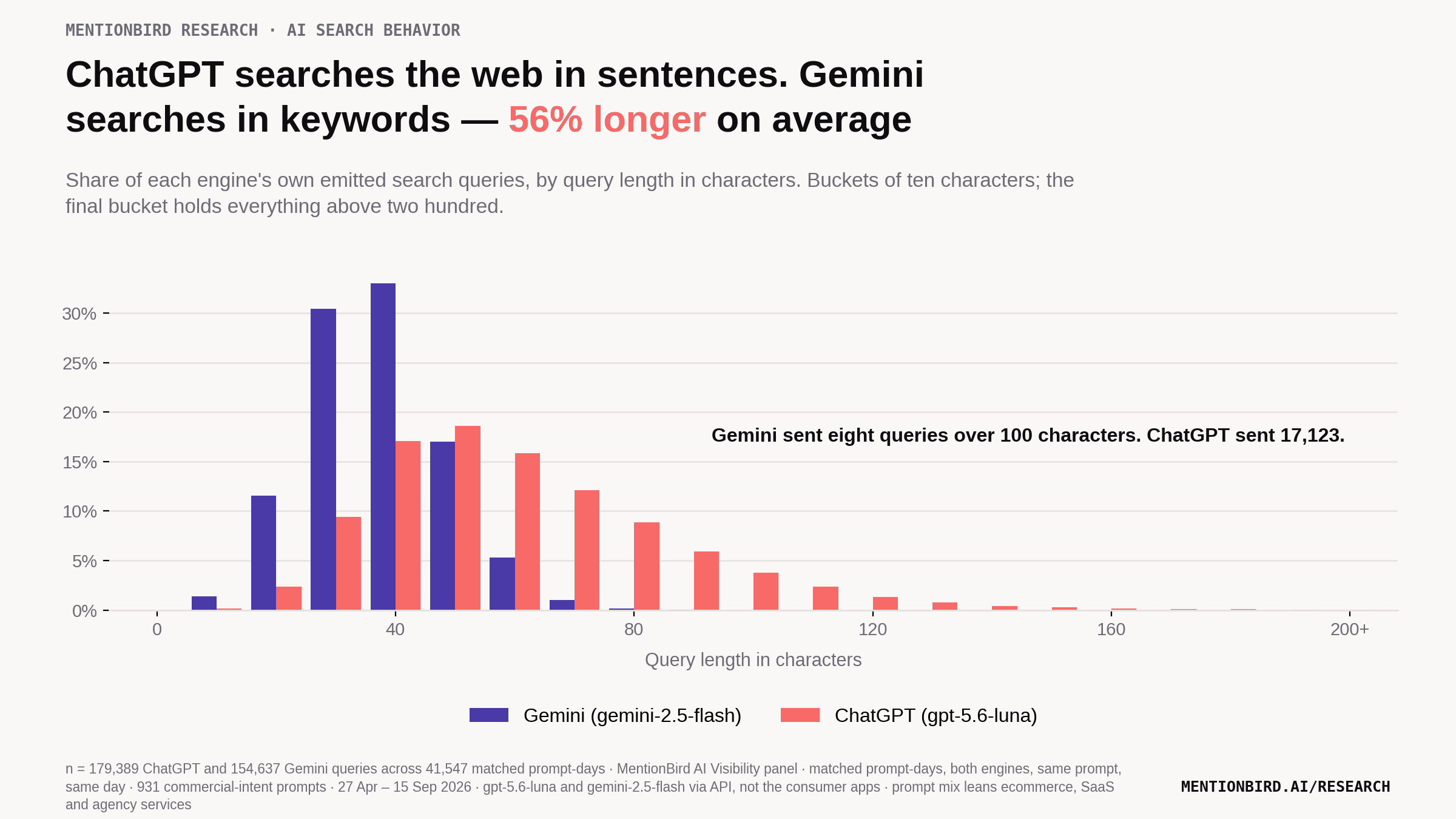
Table 1 — Query length by engine. Matched prompt-days, April 27 to September 15, 2026. n = 179,389 ChatGPT and 154,637 Gemini queries.
| Measure | Gemini | ChatGPT |
|---|---|---|
| Mean characters | 41.9 | 65.5 |
| Mean words | 6.02 | 8.83 |
| Median words | 6 | 8 |
| 75th percentile, words | 7 | 11 |
| 90th percentile, words | 8 | 13 |
| 99th percentile, words | 10 | 19 |
| Longest observed, words | 17 | 48 |
| Searches per answer | 3.67 | 4.27 |
The gap is in the tail, not the average
Two averages three words apart is a weak story. The shape of the two distributions is a much stronger one.
Gemini’s queries cluster tightly. Five, six and seven words account for most of them, and the curve falls away fast on both sides. 17.0% of its searches are four words or fewer. Only 2.4% reach ten words.
ChatGPT’s curve has no such peak. It runs almost flat from six words to nine, then declines slowly across a very long tail. 35.6% of its searches are ten words or longer. That is fifteen times Gemini’s rate.
The character view is starker. 98.7% of Gemini’s queries fit inside 70 characters. Only 63.5% of ChatGPT’s do. ChatGPT emitted 17,123 queries longer than 100 characters. Gemini emitted eight.
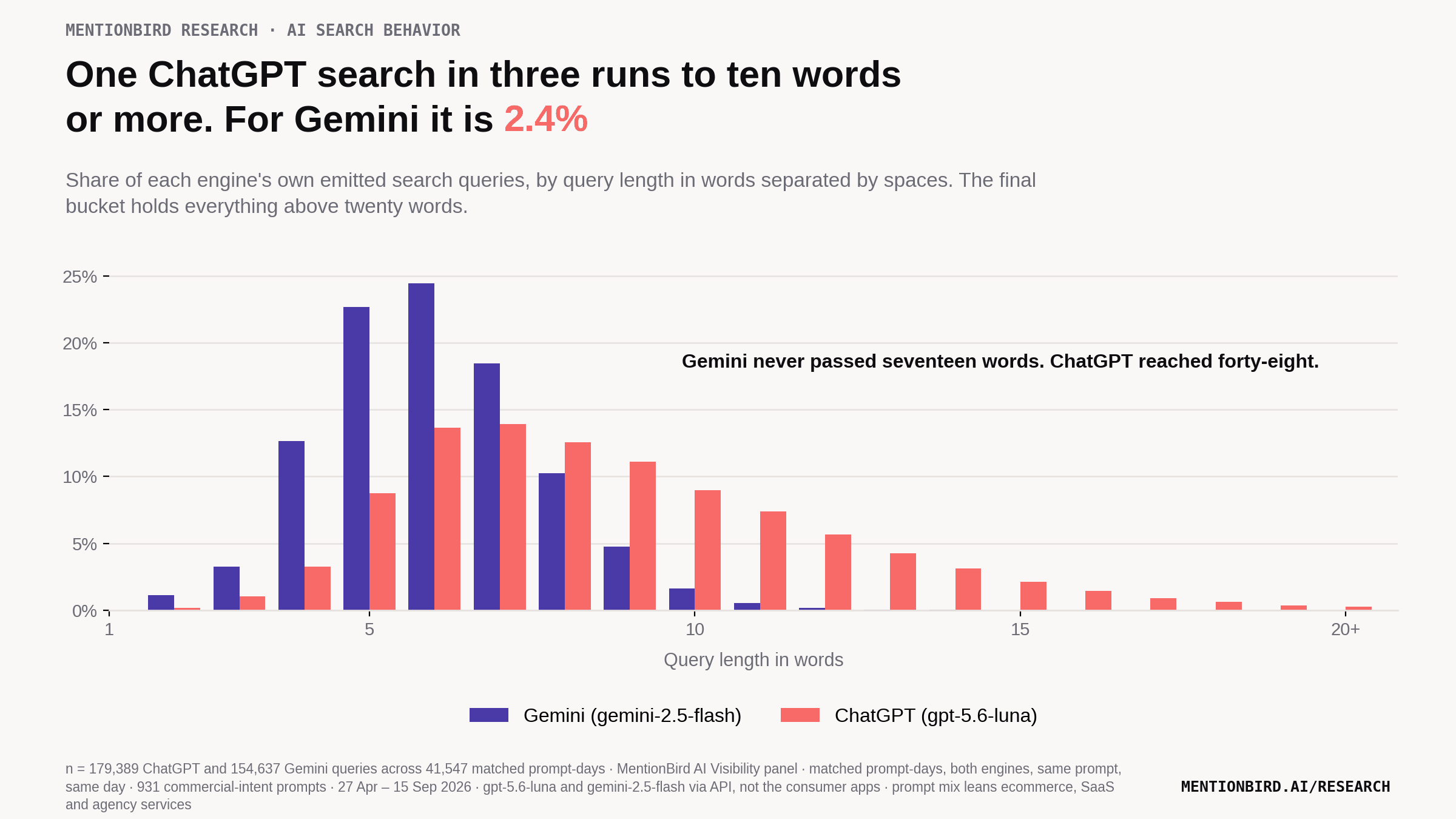
Table 2 — Share of queries by length band. n = 179,389 ChatGPT and 154,637 Gemini queries.
| Length band | Gemini | ChatGPT |
|---|---|---|
| Four words or fewer | 17.0% | 4.5% |
| Ten words or more | 2.4% | 35.6% |
| Under 70 characters | 98.7% | 63.5% |
| Over 100 characters | 8 queries | 17,123 queries |
Gemini has a ceiling. ChatGPT does not.
In 154,637 attempts, Gemini never wrote a query longer than 17 words. It crossed 100 characters eight times. Whatever governs its query writing, it behaves like a limit.
ChatGPT has no visible limit. Its longest query in the matched set ran to 48 words and past 380 characters. Nearly one query in ten crossed 100 characters. We call these two behaviors bounded and unbounded, and the distinction matters more than the averages do.
Now compare both with people. Semrush’s analysis of 160 million search keywords found that under 1% of human search queries run to ten words or more. ChatGPT’s figure is 35.6%. Backlinko’s study of 306 million keywords put the average keyword at 1.9 words. Gemini’s median of 6 is already three times that, and Gemini is the conservative engine here. Both machines search far past where people stop.
Salil Panikkaveetil, founder, MentionBird: “For twenty years the search box trained everyone to write for two or three words. These engines do not search like that. Gemini’s typical search runs to six words and ChatGPT’s to eight, and more than a third of ChatGPT’s run past ten. If your pages are built to match short head terms, they are being matched against questions far more specific than anything a person would have typed. The long tail is not the leftover any more. It is the main thing you are optimizing for.”
Human search may be moving the same way, though the evidence there is thinner. Search Engine Land published Google Ads data on query length shifting since AI Mode in August 2026. It put one and two-word queries at 24% of impressions, down from 42% in January 2025. That analysis discloses no sample size or method, so we treat it as a direction rather than a number.
ChatGPT starts broad and narrows. Gemini does not.
An engine usually runs several searches for one answer. Watching how length changes across them shows two different strategies.
ChatGPT’s first search averages 9.29 words. Its second is its longest at 9.46. From there it contracts steadily, reaching 7.12 words by the seventh search. It opens with something close to a question and ends with something close to a keyword.
Gemini does not do this. Its first search averages 6.41 words and its eighth averages 5.95. Across all eight positions it moves 0.6 words. Its fourth query is the same shape as its first: another phrasing of the same short keyword string.
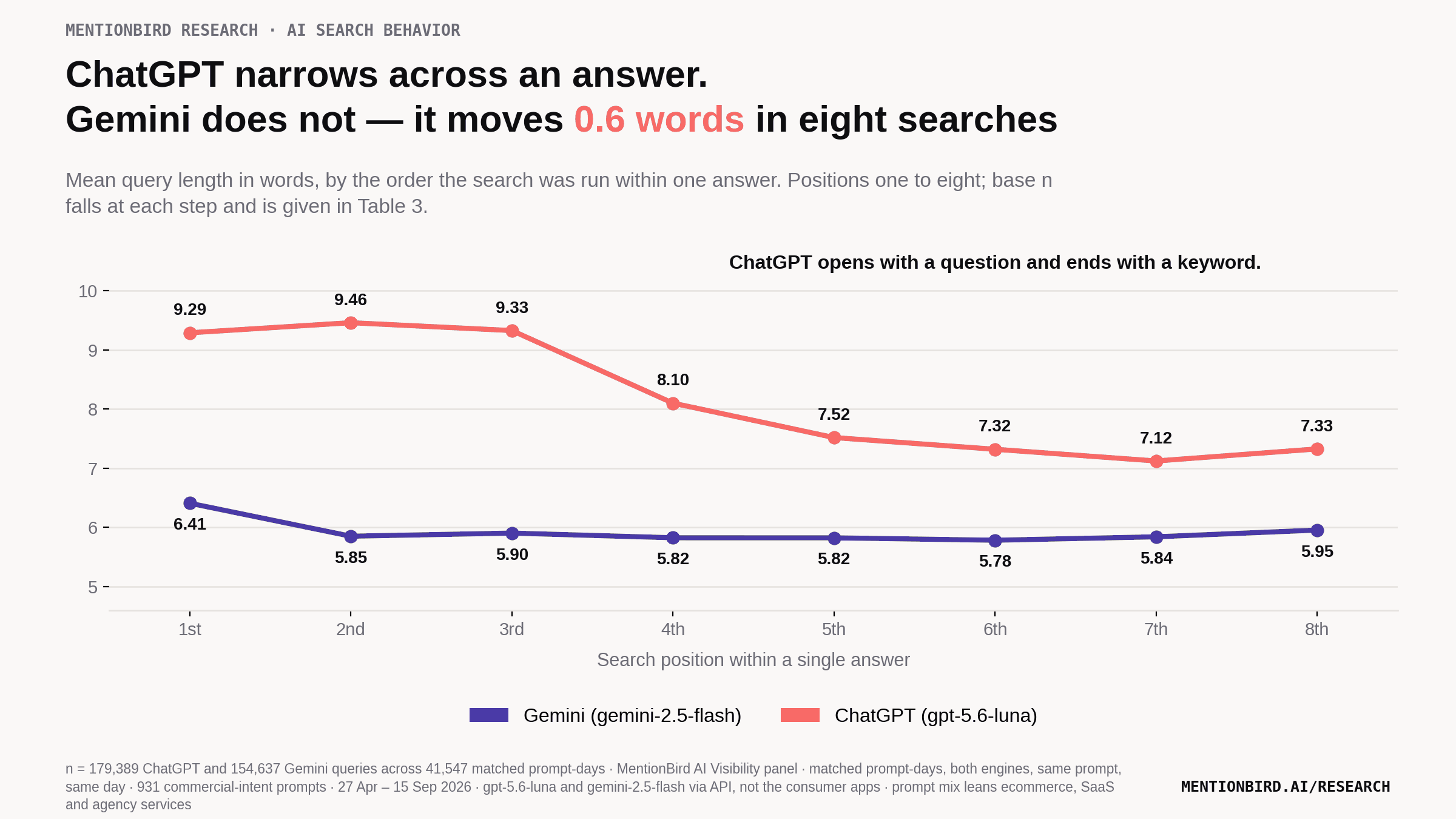
Table 3 — Mean words per query by search position. Base n in brackets.
| Search position | Gemini | ChatGPT |
|---|---|---|
| 1st | 6.41 (42,083) | 9.29 (42,024) |
| 2nd | 5.85 (41,701) | 9.46 (41,862) |
| 3rd | 5.90 (32,568) | 9.33 (38,674) |
| 4th | 5.82 (19,188) | 8.10 (23,329) |
| 5th | 5.82 (7,527) | 7.52 (13,723) |
| 6th | 5.78 (3,206) | 7.32 (9,174) |
| 7th | 5.84 (1,849) | 7.12 (5,791) |
| 8th | 5.95 (1,292) | 7.33 (2,768) |
The gap survived a change of ChatGPT model
OpenAI’s model behind our ChatGPT arm changed in late August 2026, inside the study window. We could have cut the window short. We split it instead and published both halves, because a finding that only holds on one model release is not much of a finding.
Before the change, ChatGPT’s queries were 54.8% longer in characters than Gemini’s. After it, they were 60.8% longer. Gemini barely moved on either side. The character finding holds, and it strengthens slightly.
The word measure behaves differently. There the gap narrows, from 50.7% to 34.8%. The newer model packs more characters into fewer whitespace-separated tokens. So how you choose to measure length changes what you would conclude. That is the reason every headline number in this post is a character count.
Table 4 — Query length before and after the ChatGPT model change. Base n given as Gemini / ChatGPT queries.
| Segment | Base n | Gemini chars | ChatGPT chars | Character gap | Gemini words | ChatGPT words | Word gap |
|---|---|---|---|---|---|---|---|
| Apr 27 – Aug 23 | 111,176 / 134,214 | 42.24 | 65.39 | +54.8% | 6.04 | 9.10 | +50.7% |
| Aug 24 – Sep 15 | 43,461 / 45,175 | 40.92 | 65.82 | +60.8% | 5.96 | 8.03 | +34.8% |
| Whole window | 154,637 / 179,389 | 41.87 | 65.49 | +56.4% | 6.02 | 8.83 | +46.8% |
Month by month, character length is flat for both engines. ChatGPT sits between 63.85 and 66.58 across five months. Gemini sits between 40.71 and 42.85. Neither drifts.
Table 5 — Mean query length by month. Base n is queries in that month, Gemini / ChatGPT.
| Month | Base n | Gemini chars | ChatGPT chars |
|---|---|---|---|
| April, from the 27th | 1,409 / 1,598 | 40.84 | 64.11 |
| May | 14,430 / 18,549 | 41.24 | 63.85 |
| June | 25,797 / 30,980 | 42.85 | 66.58 |
| July | 35,706 / 43,003 | 42.30 | 65.40 |
| August | 50,080 / 57,669 | 41.90 | 65.31 |
| September, to the 15th | 27,215 / 27,590 | 40.71 | 65.99 |
What to do about it
Three things follow from a query set this specific.
Write pages that answer one question completely, rather than pages that gesture at several. A query of eight to thirteen words is looking for a particular answer, not a topic.
Put the specific words on the page. Product names, use cases, comparisons, prices, integrations. Our study of what ChatGPT cites when it recommends software found 46.4% of citations went to a vendor’s own website, so these are pages you control.
Then check which prompts actually produce searches in your category. Our Keyword to Prompt Generator turns a keyword list into the prompts buyers put to an answer engine, free. Once those prompts are tracked, MentionBird's AI keyword tracking shows the exact searches each engine runs behind them.
Note: Because the two engines search so differently, the same buyer question can lead them to different sources and different brands. Keeping ChatGPT brand tracking and Gemini brand tracking separate shows where each one places you.
See how ChatGPT answers the questions your buyers ask
Run five buyer questions in your category and see whether ChatGPT names you, who it recommends instead, and which pages it cites. Free, no signup.
Get your free AI Visibility ReportWhat this does not prove
A longer query is not a better query. We measured no outcome. Nothing here says which engine retrieves more useful pages, or which is better for your brand.
Different queries do not guarantee different sources. Two engines can phrase a search differently and land on the same pages. Our study of where ChatGPT and Gemini’s sources overlap found 37.2% of cited forum pages were cited by both engines, against 9.4% of blog pages. Query length explains part of what an engine finds, not all of it.
A single query is not stable. These are averages over many runs. Ask the same question twice and the strings differ. Our study of how often ChatGPT changes its answer between identical runs found a brand’s presence flips 39.2% of the time.
We see the string, not the reasoning. We observe what the model typed. We cannot see why it chose those words.
These queries are never seen by a user. This is engine-to-index behavior. It is not a study of how people search.
Limitations
The sample is conditioned on ChatGPT having searched. A prompt-day enters the study only if both engines searched. On the questions where ChatGPT answers from memory, it has no query length at all, and this study says nothing about them. That is a large group, and it is the main boundary on everything above.
Two engines, two models. Perplexity exposes no emitted queries and Claude fell below our reporting floor. We cannot speak for either.
The ChatGPT arm spans two model versions. Table 4 is the mitigation, not a fix. A single-model window would be cleaner and much shorter.
Prompt mix leans commercial. Ecommerce, SaaS and agency services. Categories with longer or shorter natural phrasing may behave differently.
English only. Every prompt in the matched set is in English. Query length is likely to be language-dependent, and we have not tested that.
The word-count rule is crude. Hyphenated phrases and search operators each count as one word. Character counts do not have this problem, which is why they carry the headline.
Frequently Asked Questions (FAQs)
- Should I write longer pages now?
No. Length of page and length of query are different things. The finding is about specificity, not word count. A short page that answers one precise question matches a long query better than a long page that covers ten things loosely.
- Does this mean head terms are dead?
No, but they are no longer the whole job. Gemini’s median search is 6 words and ChatGPT’s is 8. Both are past where most human search sits. A page built only to match a two-word term is competing for a shape of query these engines rarely type.
- Which engine should I optimize for?
Both, and the work is not the same. Gemini rewards pages that match short, canonical category phrases. ChatGPT rewards pages that carry specific detail, because that is what its longer queries are built to find.
- Nobody searches my category in ten words. Does this apply to me?
Yes, and that is the point. Your buyers may never type ten words. The engine answering on their behalf does it in more than a third of its searches.
- Can I see the queries an engine ran for my brand?
Sometimes. ChatGPT and Gemini both expose the query strings through their APIs, which is how this study was built. The consumer apps do not show them to you.
- Would the numbers look the same in the ChatGPT app?
Probably not. We measured an API model. The app is a different product with its own retrieval behavior, and we did not test it.
- Does a longer query mean the engine understands the question better?
This study cannot say. It shows what the engine typed, not how well it did. A long query can be precise or it can be noise, and we measured no outcome either way.
Data availability
The aggregate tables are the dataset. Every number behind every chart in this post is on the page as a table, and every table is complete rather than a selection from a longer one.
We do not release the query strings. A query often contains the brand and category it was written for, so publishing them would expose which questions named brands compete on. The aggregates are where we stop. Requests for further aggregate cuts are welcome, and we will publish them as anonymized aggregates clearing the same base we require here.
What we do publish separately is the current picture. Our ChatGPT rankings pages, such as for live chat or even email marketing show which brands ChatGPT names in different software categories right now. Those are a tracker, not a study.
How to cite this study
MentionBird (2026), “ChatGPT’s web searches are 56% longer than Gemini’s”, MentionBird Research, Edition 5, covering April 27 to September 15, 2026, retrieved from https://www.mentionbird.ai/research/chatgpt-vs-gemini-query-length on [date].
License: CC BY. Republication is permitted with attribution and a link.
Note: This is Edition 5 of MentionBird Research. Every edition is collected on our research page.
See the searches AI engines actually run in your category
First month $19 with code TRY19, then $79/mo. Cancel anytime.